

The object of the game
Chkobba is played by two players, or by four in partnerships with partners sitting opposite each other. You score by capturing the cards lying face up in the middle — the table.
At the end of every round, points are awarded for four things: taking the most cards, the most diamonds, the most sevens, and the seven of diamonds itself. On top of that, every chkobba you make during play is worth a point of its own. Play continues, round after round, until someone reaches the agreed total — usually 21.
The deck
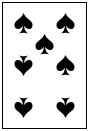
You need 40 cards: take a standard 52-card pack and remove the 8s, the 9s and the 10s. That leaves the Ace, the 2 through 7, and the three court cards in each suit. A traditional Italian deck — which comes with exactly those forty — works just as well, and is what the game was originally played with.
What the cards are worth
Here is the part that catches out every newcomer: in Chkobba the Jack and the Queen swap their usual places.
 1Ace
 2Two
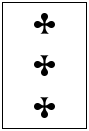 3Three
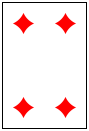 4Four
 5Five
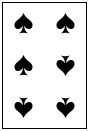 6Six
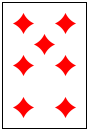 7Seven
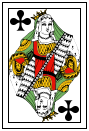 8Queen
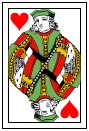 9Jack
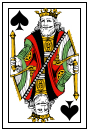 10King
The Queen is worth 8 and the Jack is worth 9 — the opposite of an ordinary card game. The King is 10, the Ace is 1, and the 2 through 7 are worth their face value. Forgetting that one swap is the single most common mistake new players make.
Dealing
- The dealer shuffles the pack thoroughly.
- The player on the dealer's right cuts and draws one card. They choose: keep it in hand, or lay it face up in the middle. This small ritual is particular to Tunisian Chkobba and does not exist in Italian Scopa.
- The dealer completes the deal: 3 cards to each player and 4 cards face up on the table. If the drawn card was kept in hand, that player takes two more and four go to the table; if it was laid down, three more cards join it there.
- If the table ends up showing three or four cards of the same rank, the deal is void — shuffle and deal again.
Once everyone has played all three cards, three more are dealt to each player. No further cards are ever added to the table. This repeats until the pack runs out.
Capturing cards
Play moves anticlockwise. On your turn you play exactly one card from your hand. There are two ways it can capture:
Capturing by matching
Your card has the same value as a card on the table: you take both.
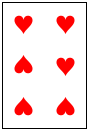

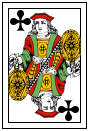
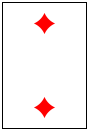
The table holds a 3, a 6 and a King. You have a 6 in hand.
Capturing by adding up
Your card equals the sum of several table cards: you take all of them.

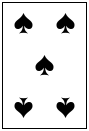
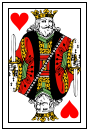
The table holds a 4, a 3 and a Queen. You have a 7 in hand.
A capture by adding up can gather two cards, three, or more — as long as the total comes out exactly right.
If your card could capture both a single card and a group, taking the single card is compulsory. You play a 7 while the table shows a 7 as well as a 4 and a 3? You must take the 7. Plenty of tables argue about this one: the official rule gives you no choice.
If no capture is possible, the card you played simply stays in the middle and the table grows. That is a decision in itself: whatever you leave behind, your opponent can take.
The chkobba
Capture every card on the table in a single move, leaving it completely empty, and you have made a chkobba. It is worth one extra point, and the card you played is left face up in your pile so that nobody forgets it when the counting starts.
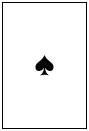
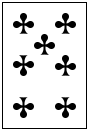
Only three cards are left on the table: a 5, a 3 and an Ace. You have a 9 in hand.
The name comes from the Italian scopa, “the broom”: you sweep the table clean in one stroke. It is the moment everyone around the table is waiting for — and the one you are expected to call out loud.
The last trick
When every card has been played, whatever is still lying in the middle goes to the player — or the partnership — who made the most recent capture.
That final sweep-up does not count as a chkobba. And the dealer can never score a chkobba with the very last card of the game — otherwise they would walk away with an advantage nobody at the table could answer.
Scoring
With the round over, each side spreads out the cards it captured and counts:
| Point | Value | How you get it |
|---|---|---|
| Karta | 1 | The most cards. Nobody scores it if both sides hold 20. |
| Dineri | 1 | The most diamonds. Nobody scores it if both sides hold 5. |
| Bermila | 1 | The most sevens. If those are level, the most sixes decides it. |
| 7ayya | 1 | Having captured the seven of diamonds. |
| Chkobba | +1 | One point for every chkobba made during the round. |
The seven of diamonds — the 7ayya — counts three times over: it scores a point by itself, it weighs on the diamonds count, and it weighs on the sevens count. Whole rounds are decided by that one card.
Winning the game
The first player or partnership to reach the agreed total wins. Most tables play to 21 points; 11 makes a quick game, 31 a long one.
If both sides cross the line in the same round, one more round is played to settle it.
Five habits of a strong player
- Count the sevens. There are only four in the whole pack. Knowing which have already gone changes every decision you make late in the round.
- Never leave the 7ayya lying there. The seven of diamonds is a point on its own and weighs on two other counts: if it appears on the table, take it.
- Think about what you leave. Playing a card that captures nothing hands your opponent an opportunity. Leave a value that is hard to complete.
- Deny the chkobba. When the table empties out, that is where the round is won: adding one card at the right moment can make a sweep impossible next turn.
- All else equal, take the diamond. The dineri point is usually decided by a card or two.
The words of the game
Chkobba is played in Tunisian, and the scoring terms are never translated — even players who learned the game in French or English call the points by these names.
Clearing the whole table in one move. From the Italian scopa, “the broom”.
The point for capturing the most cards.
The diamonds, and the point given to whoever takes the most of them.
The point for the most sevens, broken by the sixes if they are level.
The seven of diamonds, literally “the snake”. The most coveted card in the game.
Frequently asked questions
- How many cards do you need to play Chkobba?
- Forty. Remove the 8s, 9s and 10s from a standard 52-card pack.
- What is the Jack worth?
- The Jack is worth 9 and the Queen is worth 8: their usual ranks are swapped. The King is 10 and the Ace is 1.
- What exactly is a chkobba?
- Capturing every card on the table in a single move, leaving it empty. Each one is worth an extra point.
- Can you score a chkobba with the last card?
- No. The dealer can never score a chkobba with the very last card of the game. Whatever remains goes to the player who captured most recently, but it does not count as a chkobba.
- How many points win a game?
- Usually 21. Tables also agree on 11 or 31. If both sides reach the target in the same round, one more round settles it.
- How is Chkobba different from Italian Scopa?
- Chkobba descends directly from Scopa, but it has its own Tunisian character: the cutting ritual before the deal, the swapped Jack and Queen, the sevens point broken by sixes, and a vocabulary of its own.
- Can you play Chkobba online?
- Yes — here on Chkobbeta, free and with nothing to install, against real players or against the computer.
You learn the rules by playing them
There is a table waiting. Free, nothing to install, no account required.
Play Chkobba